Carbon sequestration: our commitment at Anaïk to a 360° climate strategy
At Anaïk, our climate policy is based on two pillars: reducing our emissions at source, in our operations and our value chain, and contributing to carbon sequestration projects.
Carbon sequestration: our commitment at Anaïk to a 360° climate strategy
At Anaïk, our climate policy is based on two pillars:
Reducing our emissions at the source, in our operations and our value chain—that is our priority.
Contribute to carbon sequestration projects—in addition, via an innovative mechanism: the carbon pool.
The carbon pool: turning a constraint into an opportunity
In our industry, cost and time constraints can sometimes make air transport necessary. Rather than just accepting this, we've decided to turn it into a way to take climate action.
Each customer project requiring air transport generates a contribution of €100 per ton of CO₂ emitted, paid into a dedicated fund. This fund, financed by our clients themselves, enables us to fund carbon sequestration projects with a high environmental impact.
In 2024: a soil carbon sequestration project in Germany
Thanks to this fund, more than €8,240 was invested in 2024 in a soil carbon sequestration project in Germany. This project, selected with our partner Greenly, is certified by the CSA Group and complies with the ISO 14064-2 standard, which provides a framework for quantifying, monitoring, and reporting CO2 .
This project is based on regenerative agricultural practices, which enable carbon to be stored sustainably in the soil while improving its health. It has offset approximately 106 tons of CO₂.
Carbon sequestration and regenerative agriculture: why it's essential
Carbon carbon is a vital nutrient for the soil. It promotes fertility, stimulates microbial life, and improves water retention. Soil rich in carbon is more resilient to the effects of global warming: droughts, floods, erosion, etc.
It was with this in mind that France launched, during COP21 in 2015, the "4 per 1000" initiative: If we increase 0.4% per year the carbon content of soils, we could halt the increase in CO₂ concentration in the atmosphere.
But in practical terms, how does soil sequester carbon?
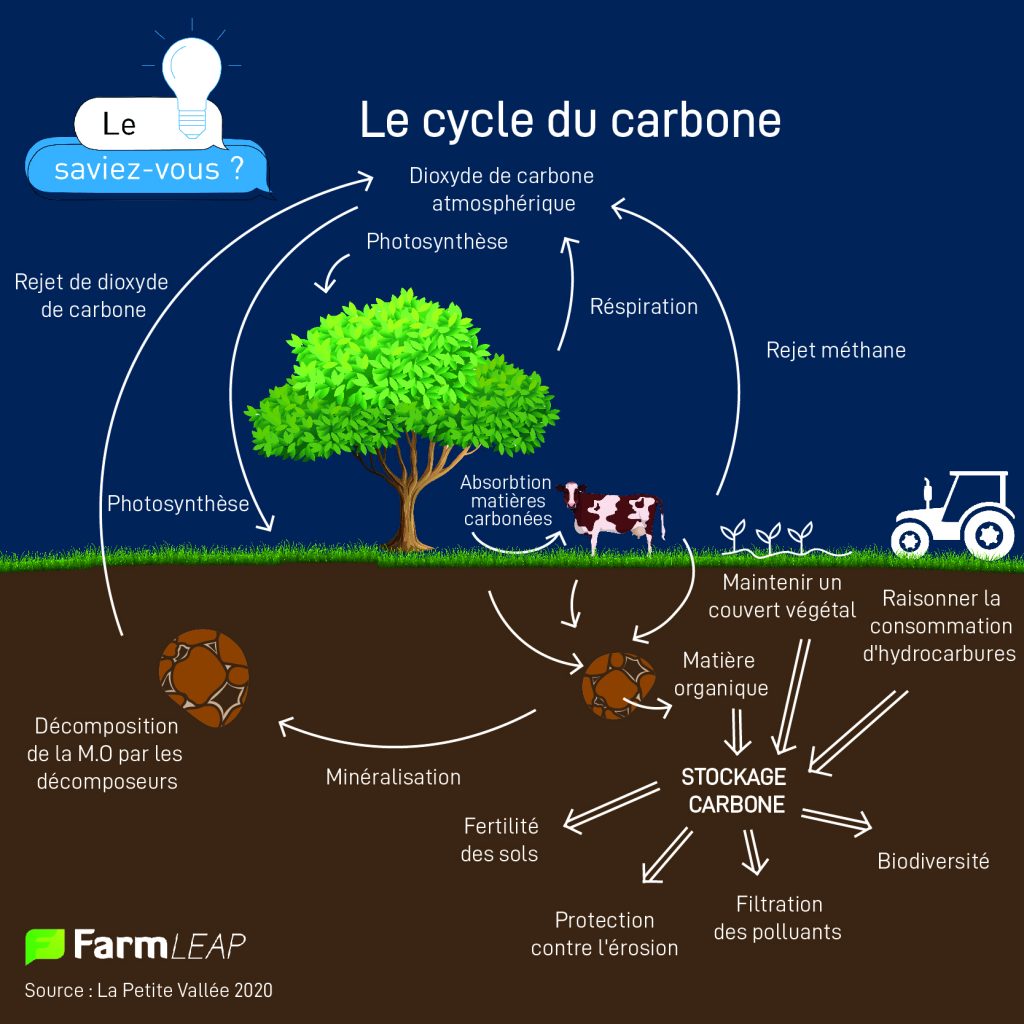
Atmospheric CO₂ is captured by photosynthesis and then converted into organic matter that accumulates in the roots and surface layers of the soil, where it can be stored long-term.
To achieve this goal, however, certain agricultural practices must be abandoned:
Intensive plowing
Excessive use of chemical inputs
The impoverishing monoculture
The carbon cycle (source: FarmLEAP / La Petite Vallée 2020)
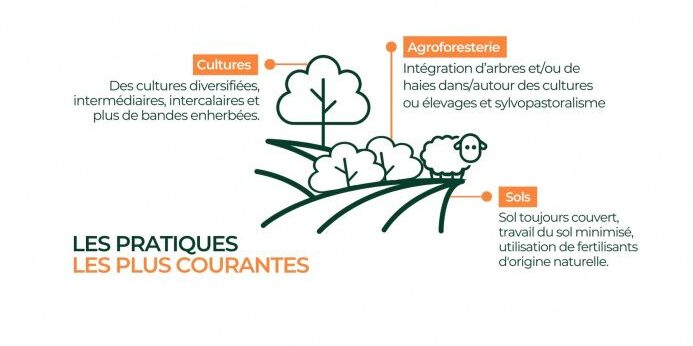
Regenerative agriculture, the basics (source: Reforest’Action)
Conversely, regenerative agriculture relies on techniques that promote biodiversity, permanent plant cover, composting, and crop rotation. It stores carbon, restores ecosystems, and improves soil resilience.
The role of businesses in climate transition
Businesses have a major role to play in reducing global emissions. At Anaïk, we have chosen tointegrate carbon contribution into our business modelby transforming an operational constraint (air transport) into an opportunity to finance environmental projects.
This model allows us to:
Taking concrete action for the climate
To raise awareness among our customers about the impact of their logistics choices
To support local and certified initiatives
Certified projects for measurable impact
All the projects we support are certified by recognized organizations such as Gold Standard or CSA Group, guaranteeing the reliability of results and the traceability of actions. This rigor is at the heart of our CSR approach.
Carbon sequestration is a complementary tool, but it does not replace the need to reduce our own emissions. It is by combining reduction and contribution that we will be able to meet the objectives of the Paris Agreement.
Founded in 1973 in Roubaix, Anaïk is a leading designer and supplier of gifts, packaging and accessories for major international brands and retailers. Its head office is located in Villeneuve d'Ascq (59). Committed to CSR, Anaïk has been integrating it into its strategies for over 18 years, becoming an expert in eco-design.